There are three things you must do in order to successfully generate ideas for your art.
1)consume plenty of ginkoboloba
2) stand on your head, count to ten while holding your breath and think happy thoughts.
3) Sit very still in a metal chair with a hat made of tin foil placed perfectly over the back of your skull.
If none of these work for you, continue reading.
In reality there are no sure fire ways to get great ideas. In a sense they come to you when you are ready to receive them and each person prepares themselves to receive ideas in different ways. Since I’m an artist I tend to think of things visually, so the methods I’ve mentioned below are mostly based on visual observation.
mind/idea web- Most people have used these before for writing papers and other projects. The basic idea is you write down a starting word, then build a web of related words around that word, then build off from each of those words as far as you can. This process often generates ideas you may not have otherwise thought of.
Observation- This method for me primarily refers to observation of nature. When you think about it most inventions are things observed from nature. We see a duck with webbed feet and think “those are cool, I’ll make me some” and we get scuba diving flippers, we see a bird flying and create airplanes etc. Artists have also observed nature to create some amazing and imaginative scenes. The more you study nature the easier it will be for you to create imaginative worlds and creatures and objects that look and feel real. Ask any concept artist where there ideas come from and they will most likely tell you that the ideas started from observation of natural and man made objects. Even if they could create a castle without any physical observation of castles then they will at least resort to there memory bank of images they’ve seen in the past.
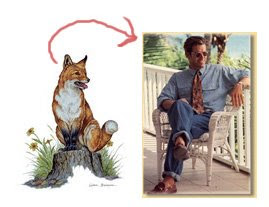 Do something to it-
This is a method that evolves over time. Take an object or a drawing and do something to it. Do something else to it. Do something else to it. This is the method I generally use to design characters until they look just right. Most people get locked into there original ideas without ever seeing if it could evolve into something better. Check out my blog titled “Graduate Pinball Painting” to see an example of a simple cartoon I developed into a larger concept for a painting.
Images- I often use tons of images to jog my mind into thinking of ideas. As a visual thinker, it helps me to see lots of other images to start mapping out ideas for my own images. Most of the ideas we have start somewhere, as creators it’s our job to find that place to start. I often start by looking through old copies of illustration directories. I’m pretty sure you can get a free copy by going here
http://www.dirill.com/ It’s also helpful to look through magazines, travel books, books about the topic you’re illustrating ,whatever works to jog your mind into action. Some of my best ideas come while I’m watching TV.
The internet- Even if you don’t happen to have tons of reference images in the form of magazines and books laying around you can always go to the internet for ideas. Find a good artist forum like
http://www.conceptart.org/ ,
http://www.wetcanvas.com/ ,
http://www.artwanted.com/,
http://www.deviantart.com/, or for images on particular subjects check out stock photos on sites like
http://www.morguefile.com/ ,
http://www.corbis.com/ , etc. if you’re looking for pictures of animals you can find zoo websites like
http://whozoo.org/gallerymain.htm . These are meant to generate ideas and help you draw particular elements. Don’t just find some photo and copy it.
Other Artists- One of my favorite places to get ideas and inspiration is to look at my favorite artists websites and read their blogs. Below are just a handful of all those who have inspired me and my art.
James Gurney
http://www.jamesgurney.com/ http://www.gurneyjourney.blogspot.com/
Dani Jones
http://danidraws.com/
Richard Watson
http://www.richardjessewatson.com/
Dan Dossantos
http://www.dandossantos.com/home.html
Tony Diterlizzi
http://www.diterlizzi.com/
Scott Burdick
http://www.scottburdick.com/
Relax- Stop trying so hard. Just relax and get away from the project for while. You may spend hours racking your brain in the studio trying to come up with good ideas and get nothing. Some of my best ideas come when I’m in bed almost asleep or when I’m walking along the sidewalk or something mundane. This does tend to happen more often when I have thought about a particular project for a while already.
Friends- Let others help you think of ideas. I think all too often artists have the mentality that they have to come up with all of the ideas or it’s not really there art. Well that really depends on what you’re talking about I guess. I wouldn’t think it’s a great idea for someone to come up with every last detail in one of your images but it never hurts to ask for help and to accept someone’s ideas when they come up with something good. Just be careful of intellectual property. If you rely heavily on someone else’s idea, then make sure they are fine with it first and give them credit where it’s due. In actuality there is often more than one mind involved in illustrating any given image in a children’s book, as mentioned in my blog discussing the process of children’s book illustration. Most of the time an illustrator is working with their client and whoever else the client shows the sketches to as well as whoever pops there head into the studio. Many people have there own opinions and ideas so I would suggest tapping into that whenever possible. Sometimes and outsider can think more clearly than someone who’s been working with an illustration for weeks. As annoying as this can be at times, it can also be helpful.
For more on how to think of ideas check out
http://www.princetonol.com/groups/iad/Files/ideas.htm